
SHIRIN NESHAT. DO U DARE!
Venice, Palazzo Marin
May 9 – September 6, 2026
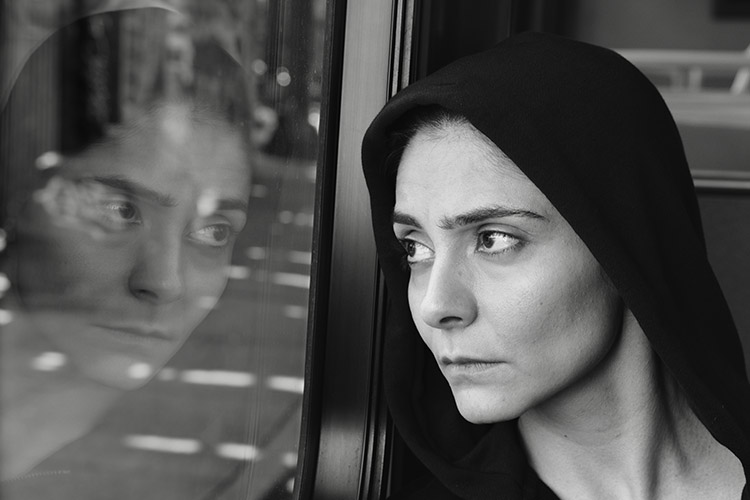
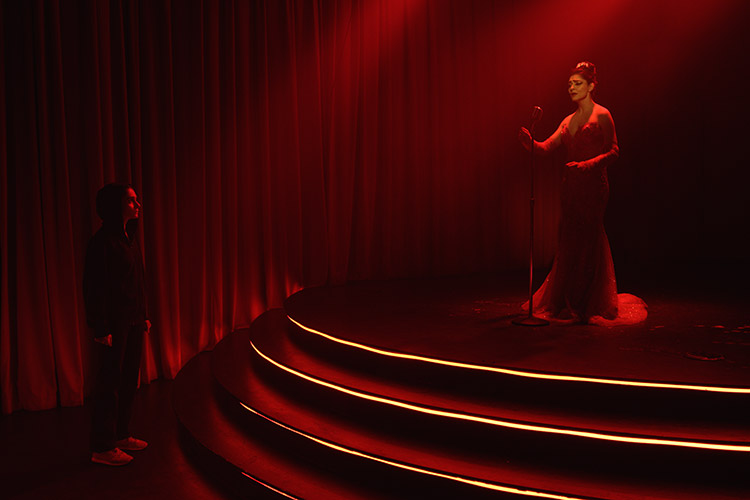
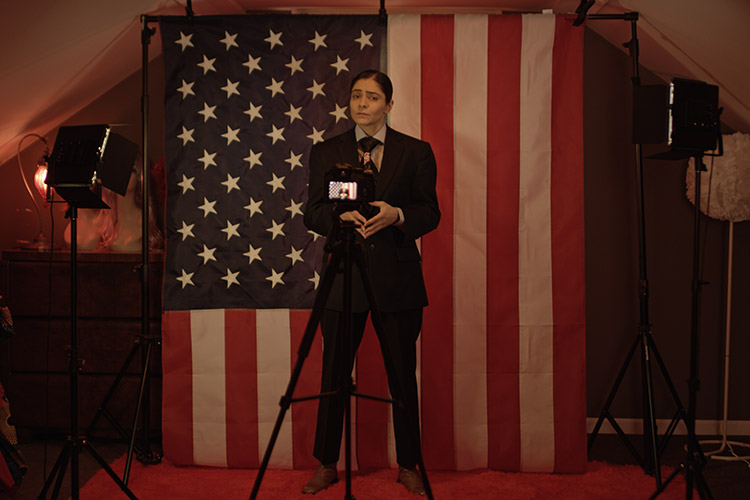
Ph. Shirin Neshat, Do U Dare!, 2025. Courtesy Shirin Neshat, Gladstone Gallery, Galleria Lia Rumma
Organized by Associazione Genesi and Banca Ifis
and presented by Gladstone Gallery and Lia Rumma Gallery
in collaboration with Magonza
Visual artist and filmmaker Shirin Neshat premieres a new film trilogy, titled Do U Dare!, in order to explores themes of displacement, isolation, protest, artistic obsession, and the line between creation and self-destruction.
This trilogy was inspired by the story of Nasim Aghdam, an Iranian woman who due to her Bahá’í faith, fled to the U.S. when she was a child to escape persecution by the Iranian government. Living in suburban California, isolated and struggling to connect with American society while also losing her connection to her Iranian heritage, Aghdam built her own imaginative world online where she performed, sang, and danced in stylized videos that spoke to her longing, rage, protest and a need to be seen. Through her videos, Aghdam mocked and ridiculed the ideological parallels between Iranian and American cultures and authoritarianism. Her performances exposed the spectacle of power, consumerism, and media-driven narcissism that dominate contemporary society. At the same time, she embodied and subverted the persistent image of women as objects of desire, and control through her provocative and unsettling videos that confronted her viewers’ expectations. Her videos went viral, gathering millions of views until YouTube suddenly shut down her channel. Devastated by authoritarian censorship akin to that which her family experienced in Iran, in 2018 at the age of 38, Aghdam entered YouTube’s headquarters armed, injured several people, and ultimately took her own life.
Each of the three videos in the Do U Dare! trilogy is a fictionalized narrative, unfolding within a distinct socioeconomic landscape of the greater New York area, forming a fragmented portrait of Nasim Aghdam’s inner world.
Set in a low-income immigrant neighborhood of Brooklyn, the first video, titled Brooklyn, follows Nasim as she moves through a community marked by poverty, exclusion, and quiet despair. Observing lives caught in bureaucratic indifference and cultural alienation, she bears witness to the cruelty beneath the American promise of opportunity. Her quiet defiance grows into mounting fury, culminating in an unexpected and radical act of protest, revenge, and a desperate need to be heard.
Filmed in the corporate core of Wall Street, the second video, titled Wall Street, places Nasim amid a dense, buzzing financial district where men and women move mechanically through their routines, emotionally vacant and disconnected. As night falls, the same soulless crowd becomes mysteriously drawn toward a disembodied musical voice. Following the pull of the sound, Nasim discovers herself at its center—transformed into a performer who commands the crowd, moving them to tears. This chapter explores Nasim’s obsession with fame, recognition, and public validation. Stardom and artistic ingenuity emerge as seductive forces—a compulsive longing to be seen, admired, and acknowledged, driven by the belief that visibility itself might confer power, relevance, and meaning.
The final video, titled Suburb, unfolds inside Nasim’s suburban home, where she secretly produces her own videos inspired by her encounters with the outside world and the media. She repeatedly performs and impersonates a series of characters—singing, dancing, and slipping between personas as a form of satire. Through these performances she ridicules America’s self-image as a global superpower,exposing the contradictions that underpin it: political hypocrisy, systemic racism, and the enduring structures of injustice that contradict the nation’s rhetoric of freedom and democracy. Her performances also point to the grotesque disparity between extreme wealth and celebrity culture on one hand, and the persistent realities of poverty, violence, and global destruction on the other. Central to this chapter is also the sexual objectification of women within American visual culture, exposing the paradox of the female body in contemporary media, how it is endlessly aestheticized, and fetishized as a symbol of beauty and desirability, yet at the same time relentlessly commodified, surveilled, and consumed.
Similar to Neshat’s previous work, in Do U Dare! the three films build from black and white social realism into a realm of magic and surrealism, illustrating Aghdam’s fragile mental state, her emotional instability through exile and displacement, her ultimate inability to distinguish between imagination and reality, and her obsession with impersonating others—experiences that resonate with many immigrants in their attempt at assimilation and belonging in America.
Through this intricate interplay between truth and fiction, past and present, Do U Dare! acts as both mirror and dialogue, a meditation on exile, loneliness, artistic obsession, and the fragile boundary between creation and self-destruction. The film questions not only the lengths to which an artist will go to be seen, belong, and reclaim her voice, but also the human cost of displacement and the redemptive power of art.